
INTRODUCTION: GAME CHARACTERISTICS
Tenni-koit is a game which is played either under daylight or under floodlights. It is played both indoor and outdoor by both sexes. The game consists of both Singles and Doubles, inclusive of Mixed Doubles. Singles is a two-player game, which is played by two players opposing each other. Doubles is a four-player game, which is played by two teams of two players each, which play against each other. In Mixed Doubles, one male and one female shall form one team.
The Court dimensions, height of the net, specifications of the koit, and other playing equipments are the same for Singles and Doubles for both sexes. But for the sub-juniors, the height of the net shall be 1.67 meters (5.6 ft.).
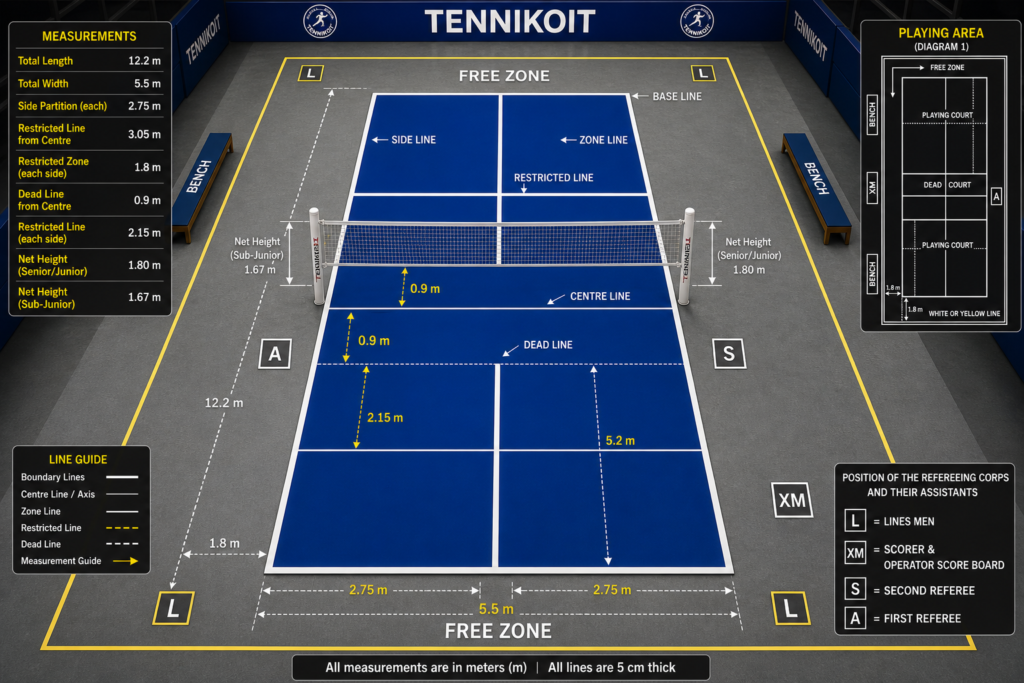
Tenni-koit is a game played by two teams or two players on a playing court measuring 12.2 x 5.5 M. The playing court is divided into two equal courts by a Centre Line. Above this line, a net is placed at a certain height.
The goal of the player is to send the koit over the net, according to regulations, to the opponent’s court. The koit is set in motion through the ‘Service’ by a player by virtue of his winning or losing the toss at the commencement of the first set and sent diagonally to the opponent’s court over the net, and the opponent(s) receive the koit over the net without any fault. The koit remains in play until it touches the floor, walls, ceiling, or any other object or until a player commits a fault. A player shall have five Services in a row, no matter whether he takes or loses the point.
Touching the dead line should be penalized; only overstepping of the dead line is “Line Cross”.
After the score is 20-all or after the 9-rally is introduced, when the stipulated time limit of 15 min. expires, each player shall have only one service in turn.
The team or player who scores 21 points with a minimum advantage of 2 points over its opponent, or in the event of the score becoming 20 each, the team/player who secures the 22nd point first, will be the winner of the set. The team which wins two sets out of three sets wins the match.
Koit is a ring made of a white thin rubber sheet filled with foam rubber. There are two types of championships:
These Rules and Regulations for the conduct of matches in the various National and Zonal Championships and all National events shall continue till further notice.
CHAPTER I: PLAYING EQUIPMENTS AND THEIR SPECIFICATIONS
Rule 1: Court and Playing Equipment
1.1 Court Measurements: (See Diagrams 1 & 2) The court shall be a rectangular, hard, even surface made of clay, red sand, concrete, or any other cementing material which enables fast movements and is free from foreign bodies which are likely to cause injury to players. It shall measure 12.2 metres in length and 5.5 metres in breadth. The two lines measuring 12.2M each shall be called the Side Lines, and the other two lines measuring 5.5M each shall be called Base Lines. A line drawn at the center between the two Side Lines shall be called the Centre Line, which shall be directly below the net. This Centre Line divides the court into two equal halves of 6.1 x 5.5M.
1.2 Court Measurement & Koit Specifications (WTF ITR Rule No.1):
1.3 Single-Court: The Single Court is a rectangle of 12.20m in length and 4.60m in width. The two lines measuring 12.20m are called side-lines, and the two lines measuring 4.60m are called base-lines. The line dividing the court into two equal halves of 6.10m in length is called the centre-line.
1.4 Doubles Court: The doubles court is a rectangle of 12.20m in length and 5.50m in width. The two lines measuring 12.20m are called side-lines, and the two lines measuring 5.50m are called base-lines.
1.5 Dead Court: One parallel line drawn on either side of the Centre Line 0.9M away from it shall be called dead lines. The area bound within the Dead Lines and Centre Line is known as Dead Court. The Dead Court shall thus measure 5.5 M x 0.9 M on either side of the Centre Line and overall measure 5.5 x 1.8 M.
1.6 Neutral Zone: The two parallel lines with a distance of 0.9m from the middle of the centerline are called deadlines. The zone from the middle of the center-line to the dead-line measures 0.90m in length and 5.50m (doubles-court) or 4.60m (singles-court) in width and is called the neutral zone. Together for both court halves, the neutral zone has a dimension of 1.80m in length and 5.50m (doubles-court) or 4.60m (singles-court) in width, but counts as unlimited in its width concerning the meaning of Rules. The dead-lines are not part of the neutral zone.
1.7 Zone Lines: The two lines drawn from the centre of the Dead Lines on either side and connected to the centre of the Base Line shall be called Zone Lines. Thus, each zone shall have an effective playing area of 5.2 x 2.75M and overall 5.2 x 5.5M on either side of the Centre Line (i.e., on either side of the net). The Zones shall help see whether all the four players are keeping their court positions while service is taken in Doubles.
1.8 Playing Zone: The zone between the side-lines, the base-line, and the dead-line at each half of the court measures 5.20m in length and 5.50m (doubles-court) or 4.60m (singles-court) in width and is called the playing zone. The side-lines, the base-lines, and the dead-lines are part of the playing zone.
1.9 Restricted or Caution Line: One more parallel line drawn on either side of the Centre Line 3.05 Mtrs away from it, or 2.15 Mtrs from Dead Lines. All Lines shall be of 5 cm width.
Rule 2: Net
2.1 Net: The net is a mesh of 70 cm wide and 6.1 M long, vertically placed over the axis of the Centre Line to divide the playing space into two parts. The net shall be made of 2.5 cm square meshes with a two-fold white cotton canvas of 10 cm wide. Each fold of 5 cm is sewn along the full length of the net over a cord or a flexible rope intersecting the respective Side Line with the Centre Line. Both the side bands shall be considered part of the net.
2.2 Tape: Two tapes of cotton material 15 cm wide & 70 cm long shall be fastened, one on each side of the end of the net perpendicular to the intersection of the respective Side Line with the Centre Line. Both the side bands shall be considered part of the net.
2.3 Antennas: The Antennas are two flexible rods made of solid bamboo, fibreglass, or similar material 1.06M long of 2.5 to 3.8 cm in diameter. The antennas shall be marked with 5 cm bands of contrasting colours preferably red and white or black and white. They are fastened on the outer edge of each vertical Side Band extending 50 cm above the top of the net. They are considered part of the net and mark its side limits.
2.4 Height of the Net: The height of the net shall be 1.8 M and be measured from the centre of the playing court using a Measuring Rod. The two ends of the net (over the Side Lines) must be at the same height from the playing surface and may not exceed by more than 2.5 cm. For Sub-Junior section, the height of the net shall be 1.67 M or 5.6 Ft. (Note: As per WTF specification, the net height is 1.65 meters at the center of the net, measured from the floor, dividing the court into two equal halves).
2.5 Quality and Measures: The net is a close-meshed canvas of cotton or synthetic fibre with a length between 5.50 and 6.10 m (meshed area) and a depth between 0.40 and 0.70 m. In case the meshed area of the net is longer than 5.50 m, the extension beyond the side-lines has to be equal in both directions. The upper edge of the net should have a different colour than the rest of the net.
2.6 Fixation: The net has to be fixed with a cord or hanger at two vertical posts of firm steel, respectively one placed on each side of the court upon the marked or imaginary centre-line with a distance of approximately 30 cm from the side-lines. The posts shouldn’t outrange a height of 1.70 m (measured from the floor) and must be qualified to warrant a strained net.
2.7 The Ring
Rule 3: Poles
3.1 Specifications: The poles for fastening the net shall be made of mild steel tubes of 6 cm outer diameter. The thickness of the wall of the tubes may be from 1.2 to 1.3 mm. The height of the poles above the floor level shall be 1.9M. A pulley or hook may be fixed to the top of the poles to secure the top cord of the net. When nets with steel stranded wire are used, suitable sprockets shall be fixed to the poles at an appropriate point for obtaining the required tension of the net and height.
3.2 Placement: The poles should be fixed 45 cm away from the centre of the Side Lines. The poles shall be lowered below ground level to a depth of 60 cm. The poles shall be painted with distinct contrasting colours in bands of 23 cm. White and Black or White and Red are recommended.
Rule 4: Koit and Court Preparation
4.1 Koit Specifications: The koit shall be made of a white thin rubber sheet filled with foam rubber and shall weigh 198 to 226 grams. The koit should be neither too hard to cause injury to the players, nor too soft to get squeezed often between the fingers and palm. The outer dia of the koit shall be 16 cm and the inner dia 10 cm. The thickness shall be 3 cm with a variation of not more than 5 mm.
4.2 Safety Zone: A zone with a distance of minimum 2.00m from the boundary (measured from the outer edge of the side-lines and the base-line) is called a safety zone and has to be marked with a line, a strained band, or a comparable delineation.
4.3 Consistence: The consistence of the Court is allowed to be out of the materials plastics, concrete or other cemented materials, clay, or red sand. It must be warranted that the surface is qualified for fast and energetic movements and is even to avoid injuries.
4.4 Location: It is acceptable to play international Tenniquoits competitions on courts which are placed outdoor or indoor.
4.5 Floodlight: In case international Tenniquoits competitions are conducted outdoors at times with no or not enough daylight, it is acceptable and necessary to illuminate the court with floodlight.
CHAPTER II: DISCIPLINES OF TENNIQUOITS
Rule 5: Disciplines and Competitions
5.1 Age Groups: Competitions as specified in disciplines are only established for one class, which is not age-restricted. Competitions are allowed to be conducted for juniors and seniors. The fixing of the age-restriction for the junior class is done by mutual agreement in the forefront of a relevant event. The senior class is not age-restricted.
5.2 Singles:
5.3 DOUBLES:
5.4 Mixed-Doubles: The discipline mixed-doubles is played by two teams, opposing each other on a doubles-court. Each team consists of one male and one female player.
5.5 Competitions:
CHAPTER III: PARTICIPANTS – DUTIES, RIGHTS AND RESPONSIBILITIES
Rule 6: Registration and Composition
6.1 Each men’s team shall consist of 6 players, one Manager, and one Coach. The women’s team shall consist of 6 players, one Manager, and one Coach. The team shall have at least one woman either as Manager or as Coach. The 6th player shall be eligible to play in Mixed doubles. It is mandatory that all Registered players must play in the championship.
6.2 All players shall be registered with the Tenni-koit Federation of India through their respective State Associations or other affiliated units.
6.3 Only the players recorded on the Score Sheet on the basis of entry forms shall be allowed to participate in the matches. No change shall be allowed on any account.
6.4 One of the players who is registered and entered for the Championship/Tournament shall be appointed as Captain of the respective team.
Rule 7: Players
7.1 Outfit: All players of both sexes shall wear proper uniform consisting of T-Shirts/Jerseys and Shorts and a pair of canvas shoes. The T-Shirts/Jerseys shall be prominently stenciled/painted with Arabic Numerals on the front and back. Shoes must be light and playable with rubber or leather soles without heels. Violation of this provision may lead to disqualification of a player/team from participation in any Championship/Tournament.
Rule 8: Duties of PLAYERS
8.1 Players should accept the decisions of referee(s) with sportsmanlike behaviour.
8.2 Players should make themselves aware of the rules of the game.
8.3 The conduct of the participants should be in accordance with the spirit of fair play and as mentioned below:
Rule 9: Coaches / Managers
9.1 Responsibilities of the Coach:
CHAPTER IV: GAME INTERRUPTION AND RESULTS
Rule 10: Toss and Warm Up
10.1 Toss is to be taken by the referee outside the court before the commencement of the match.
10.2 Warming up should also be done outside the court.
10.3 Teams are to be escorted by the referee and his assistants.
Rule 11: Game Interruption
11.1 Official Interruptions: Official interruptions of the game are those stoppages of the game that are caused by natural phenomena like bad light, heavy rains, storms etc., and ordered as such by the referee and shall include the time-outs granted by the referee on request by the player/coach as per rules hereinafter mentioned.
11.2 A maximum of one time-out is permitted in each set.
11.3 An interruption shall be granted only on request by the player/coach through the use of respective official signal.
11.4 The Coach may also speak to his Team/Player without trespassing the boundaries of the court.
11.5 After the request of the players, the referee may authorize medical attention to be provided on the Court.
11.6 A Team/Player requesting more interruption than is allowed will receive a warning by show of a Yellow Card.
11.7 In the event of serious injury/accident to a player, the referee shall stop the game and give 3 minutes to the injured player to recover. He may at his discretion restart the match before the expiry of 3 minutes accordingly as the case may warrant.
11.8 Interruption Faults: a) First Time – Warning b) Repetition – Point/to opponent set/matches as the case may be.
11.9 Prolonged Interruption during the match: If any unforeseen circumstances prevent a match from being conducted, the referee, the organizers, and the jury, if present, shall decide the measures to be taken to restore normalcy.
Rule 12: Game Results
12.1 Scoring a Point: A Team/Player shall score a point, both positive and negative (i.e., either he may complete a rally successfully and take a point, or the opponent may give a point either by failure to receive and return the koit properly or by committing fouls which are penalized by the referee).
12.2 Scoring of Points (Basic Understanding): Scoring a point is possible in an active or passive way. Scoring actively means the main action, which leads to a point, goes out from the player who wins the point. Scoring passively means the action, which leads to the point, is caused by an unforced fault of the opposing player or party.
12.3 Active Scoring:
12.4 Passive Scoring: A player or team, whose opponent commits an unforced fault, scores a point.
12.5 Direct Scoring: The chance to score a point is not dependent on the right to serve. Both sides, the serving side and the receiving side, are capable of scoring the point.
12.6 Winner(s) of a Set: The winner(s) of a set is/are the player/team that scores 21 points first. When deuce is called (i.e., when the score is 20 each), the winner(s) will be the team/player who secures the 22nd point first.
12.7 Match Winner:
CHAPTER V: PLAYING ACTIONS AND FAULTS
Rule 13: Playing Actions
The koit in play must have an upward direction when released from the hand. Referees must strictly penalize absence of such tendency without fail.
13.1 All matches are decided by best of 3 sets, each set consisting of 21 points. In the event of 20 each, the player/team scoring the 22nd point first wins the set.
13.2 The player is allowed to dive on the ground to retrieve the koit. In such an event, the player must release the koit in the process of getting into the normal position. The player is also allowed to take support from the other hand while getting back to the normal position. (Reason: to add thrilling effect to the spectators. To maintain the fluid motion of the koit exchange. The caution line has no relevance, hence removed).
13.3 In case the points scored by players/teams are equal at the completion of 20 minutes, the game will be extended by another 10 minutes with 5 minutes each half; player/team shall change the court. If the score remains equal at the end of 10 minutes, the game shall be decided by breaking with one point (the player/team securing the very next point will be declared as winner).
13.4 The game is set in motion with the start of Service. The choice of Service/Court by a player or a team is decided by the toss of the coin by the First Referee. The player/team starting Service in the first set shall receive the First Service in the Second set. In the third set, if any, there shall be no toss for the choice of Service/Court. The player/team starting the Service in the first set shall start the Service again in the deciding third set.
13.5 The time limit for each set is 15 minutes. After the expiry of 15 minutes, the server should take the point within 9 rallies failing which the point shall go to the opponent(s).
13.6 The game shall be for 20 minutes duration, and player/s shall change courts after 10 minutes (2 halves with 10 minutes each). The winner will be the one player/team who scores a higher number of points to his/their credit.
13.7 Play Time and Extensions:
13.8 A rally is complete if the koit completed one to and fro journey.
13.9 Service shall always be cross-court diagonally, but the first return of a Service may be anywhere in the opposite court.
13.10 While serving, a player should neither touch nor cross the base line before releasing the koit. He may take a run if he chooses, so long as his legs are away from the base line and the koit is not released.
13.11 Forehand and backhand services are allowed; vertical flat services are allowed. But line cutting, wobbling, shaking, etc., which are foul in nature, are not allowed.
Rule 14: Match Conduct and Rules
14.1 No overhand shots in whatsoever form (Forehand, backhand) will be allowed either during service or in play.
14.2 A koit touching the net during the Service will not qualify for a ‘let’ and the point shall be awarded to the opponent(s).
14.3 A player shall have five Services in a row, no matter whether he takes or loses the point. Service is always started from the right half court of the Server. After a point is scored, the next Service is taken from the left half court. This process shall continue until the end of the fifth serve. There shall be a side over now, and the next five services shall be taken by the opponent and he too shall start the Service from the right half court and complete five Services alternatively. Thus, the side-over takes place after the end of five services by a player.
14.4 Backward Service with up tendency without any fault shall be allowed.
14.5 When the score is deuce at 20 all, Service will change hands for every point. In other words, a player will have only one Service in turns instead of the normal five Services. After this stage, all Services are taken only from the right half court of the Server irrespective of the position of the score. Likewise, when 9 rallies are introduced after the expiry of 15 minutes allowed for the completion of a set, Service will change hands for every point, and all Services shall be taken only from the right half court of the server irrespective of where the score stands.
14.6 The koit shall be received and released with one hand (either hand being permissible for a particular delivery) as long as there is no fault while delivering the koit.
14.7 All deliveries shall have an upward tendency.
14.8 A relatively constant or motionless hazard shall not qualify for a re-service. But any disturbances caused to a player by sudden occurrences which are beyond his control shall qualify for a re-service at the discretion of the first referee.
14.9 A koit striking any boundary line either in Service or in rallies, except the side-lines of the Dead Court, shall be deemed to be right. The first pitch of the koit shall be taken into account to decide whether the koit has landed in or out of the court.
14.10 After the introduction of the 9 rallies, there shall be no further time limit for the completion of a set.
14.11 No player at any time during play shall stand in the Dead Court or tread its boundary lines during play and violation shall be penalized. A player shall, however, enter the Dead Court to pick a koit that has come to rest after duly called foul by the First Referee.
14.12 A koit hitting the antenna pole or sailing away from it and falling into the court shall be deemed out.
14.13 A koit is prohibited from entering through the net (meshes) and falling into the court.
14.14 A net broken during the rally will be eligible for a re-service.
14.15 A koit broken during the rally will be eligible for a re-service.
14.16 A player is prohibited from taking the support of the post or other playing equipments while receiving or releasing the koit.
14.17 In case of serious injury to a player or for any other reason, the First Referee may call official time-out after the koit becomes dead on completion of that particular rally. If the player is unable to continue to play within 3 minutes of the occurrence of the injury, he shall be deemed to have lost the Match by default. Likewise, in Doubles, when one of the partners in a team retires hurt, the team shall lose the match by default, as no substitution is allowed.
Rule 15: Additional Service and Play Rules
15.1 The Umpire shall have discretion to allow a maximum of 5 minutes in case of injury to player/s during the play; however, this injury time shall be within 20 minutes of the game. If the injured player/s failed to recover and resume play, the opponent player/team shall be declared as WINNERS.
15.2 During Service and rallies, wobbling and shaking are not allowed. All deliveries should be perfect and graceful as a result of wrist work. A koit wobbling or shaking after hitting the top cord of the net is, however, not penalized.
15.3 The Doubles/Mixed Doubles shall be played alternately, i.e., a player should not receive and return the koit twice consecutively during play. All four players of the two opposing teams shall receive and return the koit alternately among themselves until a point is scored.
15.4 The Captain of the team, which is to serve in the first set by virtue of either winning or losing the toss, should notify the scorer as to who will serve first. The Captain of the opposing team shall notify the scorer as to who will receive the first service.
15.5 At the commencement of each set, Service shall be started from the right half court of the server. After a point is scored, no matter which team has got the point, the next service shall be from the left half court of the server. This process shall continue until five services are completed by a player.
15.6 The Partner of the server shall stand in the adjacent court while service is made. He can occupy any place on his court after the koit has left the hand of the server.
15.7 The court position of the players of the opposing team at the time of each Service shall not change for every point scored until five services are completed. After the Service is made, they can, however, stand at any place in their court.
Rule 16: Foul Strokes
16.1 The following are the foul strokes which are penalized:
16.2 Wobbling: Lateral or longitudinal revolving of the koit is called wobbling.
16.3 Shaking: Violent vibrations of the koit caused as a result of failure to impart wrist work is called Shaking.
16.4 Throwing: Flinging the koit illegitimately in the opponent’s court is called Throwing.
16.5 Delay: There shall be a continuous motion while catching or releasing the koit. The motion shall not be marred in the process of release of koits, failing which is delay.
16.6 Pushing: Shoving the koit with a jerk is called Pushing.
16.7 Carrying: If the koit is received above the head or slightly behind it and the arm is swung backward in half-a-cart-wheel formation before release, it is Carrying.
16.8 Body Touch: If the koit, while receiving or releasing, touches any part of the body of a player inclusive of the garments worn, with the exception of palm and fingers, it is called Body Touch.
16.9 Pressing: If the koit is thrust downward with the help of either the indicator or other finger during release, it is called Pressing.
16.10 Dead-Koit: If the koit lands without any spin or force, it is called Dead Koit.
16.11 Stepping: If after receiving a koit a player takes one or more steps and then releases the koit, it is called Stepping. But a step can be taken after the koit is released.
16.12 Squeezing: While receiving or releasing the koit, if it gets crushed or compressed between the palm and fingers, it is called Squeezing (otherwise known as Punching).
16.13 Baulking: If the follow-on of the koit is not continuous but is changed instantaneously to some other direction involving delay, it is called Baulking.
16.14 Jumping: If both the feet of the player are in the air at the time of releasing the koit, it is called Jumping. But, Jumping is permitted after processing receiving the koit.
Rule 17: Faults and Sanctions
When participants commit faults during the game due to actions contrary to the rules or due to misconduct, the first referee judges the faults and determines. The sanction is applicable in accordance with the following principles:
17.1 Faults: Each fault, as specified below in this rule-set, has to be penalized by the referee through awarding one point to the opposite side.
17.2 Game Faults: These are individual actions or team movements contrary to the rules of the game and they consist of:
17.3 Consequences of a Fault:
17.4 Misbehaviour: Misbehaviour towards officials, opponent(s), spectators, or teammates shall be an offence and the sanction(s) thereof will be as follows:
17.5 Sanctions for Misconduct: Depending upon the degree of the misconduct according to the judgement of the first referee, the sanctions to be applied are:
17.6 Sanction Scale (Misconduct Scale): The repetition of a misconduct by the same member of the team during the same set calls for the gradual application of the sanction scale.
CHAPTER VI: REFEREES AND REFEREEING
Referees are the authorized representatives of the sports/games organization which has deputed them to officiate the matches. Referees, as their very designation implies, are expected to be impartial to the core. While carrying out their duties, they shall remain calm, cool, and composed under testing circumstances and maintain their balance of mind when it is disturbed by provocations, intimidations, and the like, from the players or spectators or from any other sources. They shall maintain good relationships with assistants, managers, coaches, captains, and players by their pleasing manners on the courts. They shall wear proper uniform as approved by the Tenni-koit Federation of India.
Rule 18: Refereeing Corps – Procedures and Official Hand Signals
18.1 Composition of Refereeing Corps: The refereeing corps for a match shall be composed of the following officials: One First Referee, One Second Referee, One Scorer, and two or four Linesmen.
18.2 Refereeing Procedures: a) The first referee gives the signal for the service that begins the rally. b) The First and Second referee signal the end of the rally, provided they are sure that a fault has been committed and provided further they identify its nature. c) To indicate that they authorize or reject a team request. d) The first referee may do so in order to give a warning or to penalize a misconduct by a member or by a team. e) Show the nature of the fault with official signal. f) Signal which player or team wins a point. g) Show the team serving next.
18.3 Referees Official Hand Signals: The referee and linesmen must indicate by the official hand signals the nature of the faults called or the purpose of the interruptions authorized.
Rule 19: First and Second Referee
19.1 Position: The first referee carries out his duties seated or standing on a referee’s stand located at one end of the net. His view must be approximately 18″ above the level of the upper edge of the net.
19.2 Second Referee Position: The second referee performs his duties standing on the opposite side, facing the first referee. At the moment the koit is served, he must be along the extension of the front side of the receiving team. Afterwards, he may move in front of the scorer, along the free zone.
19.3 Authority of the First Referee:
19.4 Responsibilities of First Referee:
19.5 Authority and Responsibility of the Second Referee: He is the assistant to the First Referee.
Rule 20: Scorer
20.1 Scorer: The scorer keeps the Score Sheet according to the rules, making all necessary recordings to control the game.
20.2 Position: The scorer performs his duties seated at the scorer’s table on the opposite side and facing the first referee.
20.3 Authority:
20.4 Responsibilities:
Rule 21: Linesmen
21.1 Linesmen: They are responsible for signaling faults assigned to them.
21.2 Location:
Rule 22: Protests
22.1 Protests shall not normally be entertained on matters of fact or accuracy of judgement. They shall be entertained only on technical aspects like ineligibility of players, use of colour koits, etc.
22.2 Protests should contain all information for their proper disposal and should be noted by the team captain in writing on the Score Sheet immediately at the end of the match.
22.3 The First Referee, on his part, shall submit his report to the Jury of Appeal with all facts to enable the latter to take a correct decision on the protests. The decision of the Jury of Appeal shall be final and binding on all parties.
REFEREE’S OFFICIAL HAND SIGNALS
(DIAGRAM NO: 1 TO 5 )
REFEREE’S OFFICIAL HAND SIGNALS
(DIAGRAM NO: 6 TO 10 )
REFEREE’S OFFICIAL HAND SIGNALS
(DIAGRAM NO: 11 TO 15 )
REFEREE’S OFFICIAL HAND SIGNALS
(DIAGRAM NO: 16 TO 20)
REFEREE’S OFFICIAL HAND SIGNALS
(DIAGRAM NO: 21 TO 23)
APPENDIX: World Tenniquoits Federation Game Rules up to 2006
These rules shall be applicable till March 2006. For further details please contact: Mr. REINHARD PLOG, Sec. Genl., WTF Limperstr., 23, 45657, Recklinghausen, Germany. Tel: 02361-108030

Official Address:
Tennikoit Federation of India,
Office At: 56, West Street, Bahour,
Pondicherry - 607402
Mail ID: tennikoitfederationofindia@gmail.com
©2026.TKFI. All Rights Reserved.
Last Updated on 01.09.2026